
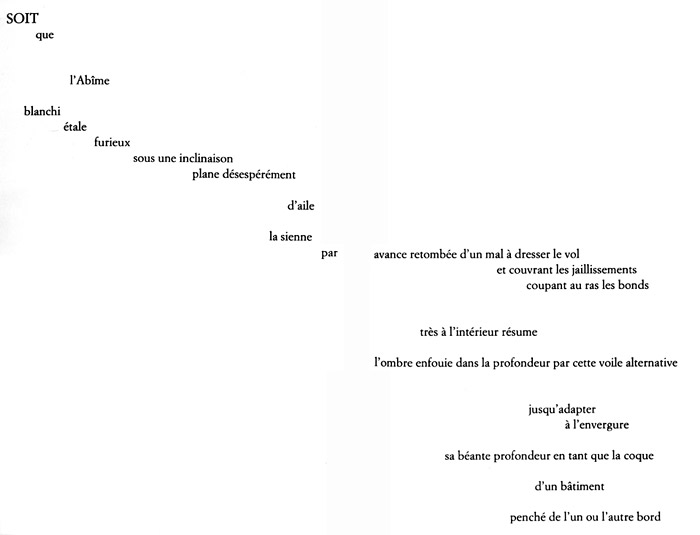
I stumbled across this poem by Stéphane Mallarmé recently…

...and was impressed that the innovative layout was created back in the 19th century.
Some digging reveals Mallarmé was a French poet who often used interesting layouts and “typographical idiosyncrasies” as part of his poems. His style wound up greatly influencing how words were displayed in poetry and beyond.
His fin-de-siècle style anticipates many of the fusions between poetry and the other arts that were to blossom in the Dadaist, Surrealist, and Futurist schools, where the tension between the words themselves and the way they were displayed on the page was explored. But whereas most of this latter work was concerned principally with form, Mallarmé’s work was more generally concerned with the interplay of style and content. This is particularly evident in the highly innovative Un coup de dés jamais n’abolira le hasard (‘A roll of the dice will never abolish chance’) of 1897, his last major poem [above].

Mallarme.com offers further description of his “word music.”
According to his theories, nothing lies beyond reality, but within this nothingness lies the essence of perfect forms and it is the task of the poet to reveal and crystallize these essences. Mallarmé’s poetry employs condensed figures and unorthodox syntax. Each poem is build around a central symbol, idea, or metaphor and consists on subordinate images that illustrate and help to develop the idea. Mallarmé’s vers libre and word music shaped the 1890s Decadent movement. For the rest of his life Mallarmé devoted himself to putting his literary theories into practice and writing his Grand Oeuvre (Great Work). Mallarmé died in Paris on September 9, 1898 without completing this work.
Nikhil Mulani
on 23 Aug 07If you are interested in that sort of typographical experimentation, you might want to take a look at the book House of Leaves, by Mark Z. Danielewski. The author tried to make the text ‘cinematic’, because the text format changes as the mood and environment in the book changes. For example, in a section where the character is wandering through a labyrinth, the text is displayed so that it too resembles a labyrinth. The book is even worth reading just for the engrossing and thoughtful story.
Esteban
on 23 Aug 07Another example to tell us that everything is already invented, and yet everything is still to be discovered.
Greg
on 23 Aug 07For a fresh take on Mallarmé’s Grand Oeuvre, you might be interested in an artists book done by Klaus Scherübel and published by Printed Matter, New York, Mallarmé, The Book (2004). Mallarmé famously said, “Everything in the world exists in order to end up in a book” and his Grand Oeuvre was to be this book. From Printed Matter’s description of Scherübel’s homage:
“[Mallarmé] envisioned The Book as a cosmic text-architecture: an extremely flexible structure that would reveal nothing short of “all existing relations between everything.’”
A fascinating goal, appropriate to its time, and still driving us today.
Matteo
on 23 Aug 07Do you know Apollinaire’s calligrams? Or don’t you know Zang Tumb Tumb by Filippo Tommaso Marinetti?
brew
on 23 Aug 07Apollinaire is a master, for sure… you can google “concrete poetry” and come up with a million varieties of text/poetry… if any can beat “Il Pleut” I don’t know…
Jason DeFontes
on 23 Aug 07Another interesting book to check out is Radical Artifice: Writing Poetry in the Age of Media, by Marjorie Perloff.
Unagriot
on 24 Aug 07A poet named Aric Allen is using embedded links in his poems in a way that Mallarme would appreciate.
Miquel
on 24 Aug 07Mallarme’s work reminds me Brossa’s plastic poetry. Joan Brossa (Barcelona, Spain 1919 – 1998) was a poet, playwright, graphic designer and plastic artist.
Joan Brossa in the english wiki
Joan Brossa in the catalan wiki
Terrence Wood
on 24 Aug 07Similar to concrete poetry http://en.wikipedia.org/wiki/Concrete_poetry
Sébastien Orban
on 24 Aug 07It’s kind of touching when another culture discover, well, our culture (I’m from the french speaking part of Belgium). It never occurs to anybody that our neightbour didn’t know what we thought everybody know!
If you like those work of typography, try to find some info on the Dada movement!
Stan Hansen
on 25 Aug 07Lawrence Ferlinghetti A coney island of the mind is very similar in style. At $10 and less than 100 pages it is my kind of poetry book. A Great Beatnick work.
Angad
on 29 Aug 07The online english translation of this poem tries to follow his french typographical style with some startling effects – http://www.ubu.com/historical/mallarme/dice.html
Angad
on 29 Aug 07Sorry, not the HTML. Try the Pdf here – http://www.ubu.com/historical/mallarme/
This discussion is closed.